
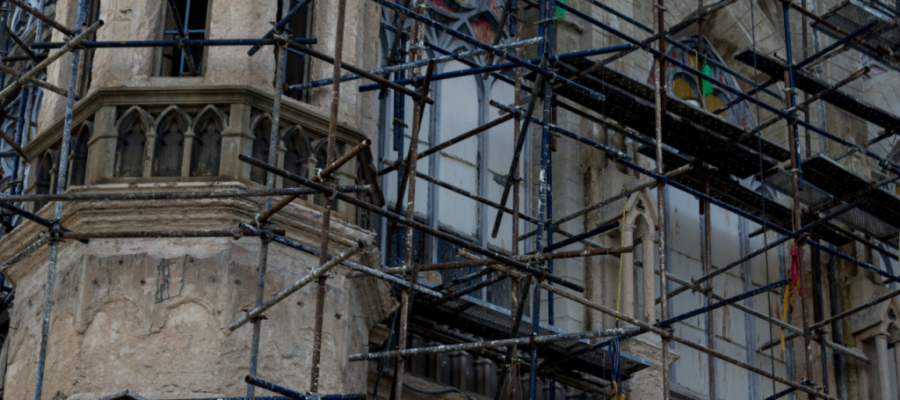
The preservation of cultural heritage is a responsibility shared by all of society, but there is one professional who plays a crucial role in this process: the conservator-restorer.
Combining technical and artistic knowledge, this professional restoration and conservation work on works which tells the story of a society. Thus, guaranteeing that the historical and cultural heritage of cities can survive the tests of time.
The profession of curator-restorer
With this in mind, Casoca explains how architecture and conservation complement each other. In addition to understanding how the profession of conservator-restorer can be a viable career path for architects.
The curator-restorer is responsible for the preservation and restoration of cultural propertywhich can range from works of art to historic buildings. But make no mistake, even if this work seems technical, it is also deeply sensitive and humanized.
Working to analyze conservation conditions and diagnose damage, this professional also offers appropriate recovery interventions using a variety of techniques and materials that respect the integrity of the object or structure.
Training in architecture provides knowledge that can be extremely useful in the practice of conservation-restoration. After all, an architect’s work, whatever its specification, involves understand structures, materials and historical contexts.
The acquired critical and aesthetic outlook also makes it possible to find the hidden potential in many degraded spaces. An example of this intersection is the restoration of historic churches, where understanding sacred architecture is crucial to developing interventions that respect the original character of the building.
In this case, the aesthetic and technical perception
of the architect becomes a valuable differentiator, because it helps to promote the enhancement of a heritage site.
There is no direct training to practice the profession of restaurateur-restaurateur. However, undergraduate architecture courses are a great place to start.
After initial training, the architect can do specializations and postgraduate degrees focused on conservation and restorationdeepening your knowledge of specific techniques, environmental legislation and art history.
In addition, it is essential that the professional develops practical and theoretical skills related to material diagnosis, restoration techniques and conservation methodologies.
However, when it comes to action, conservation-restoration is not without challenges. Lack of financial resources, bureaucracy in restoration processes and resistance to intervention on historic properties are some of the obstacles.
However, the growing awareness of the importance of preserving cultural heritage and the creation of public policies aimed at the region have opened the doors to the work of conservators-restorers.
A case study on the profession of conservator-restorer is the Bom-Será Projectcreated by the Instituto de Arte Contemporânea de Ouro Preto (IA).
The action promoted restoration of three listed colonial houses in the Cabeças district, located in the historic city. The residences belonged to modest families and date from the 18th and 19th centuries.
In addition to the restoration work, the project team offered practical workshops in the areas of carpentry, masonry, painting and installations, carried out in the houses themselves, aimed at training local construction professionals.
Other educational activities promoted include lectures on heritage education and preventive maintenanceintended for residents and students of the region.
The first restored house was delivered in December 2022 and the others in early 2023. The project was sponsored by the Vale Cultural Institute, through the Federal Law of Incentive to Culture, and with the support of the Federal Institute of Minas Gerais (IFMG).
Architectural restoration is already influenced by several technological innovations, sustainable practices and more inclusive and collaborative approaches.
3D scanners, drones
and BIM modeling (Building Information Modeling) These are some of the tools that allow a more detailed study of structures, damage mapping and intervention planning with extreme precision.
In the area of sustainability, the use of ecological materials and the reuse of original historical elements ensure that interventions are less aggressive for the environment and more consistent with the principles of the circular economy.
Another essential aspect for the future of architectural restoration is heritage education and the involvement of local communities in conservation processes.
Inclusive projects, which integrate residents, local artisans and public managers, have shown that community engagement not only enriches project outcomes, but also strengthens the cultural and social connection with the restored assets.
Finally, restoration tends to become a more interdisciplinary discipline, uniting architecture, history, archeology and engineering with the aim of preserve not only physical structuresbut also the symbolism and cultural identity of each building.
Latest Posts Published
Building materials in indigenous architecture
Architect Siza Vieira
Discover the history of Milan Design Week

How to create a good closet design?

discover the program created exclusively for architects and designers
ancient tradition that turns out to be a current solution to heat

11 Great Wireless Smart Light Ideas
Development of farms and barns: rustic elegance in Tuscany

know what they are really looking for