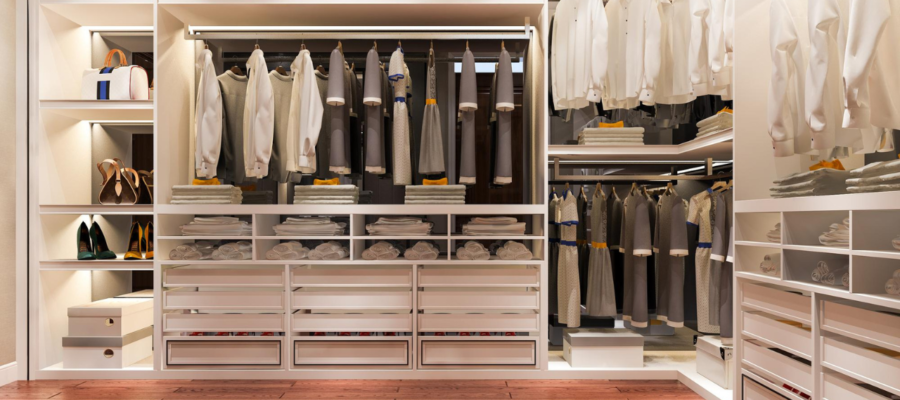
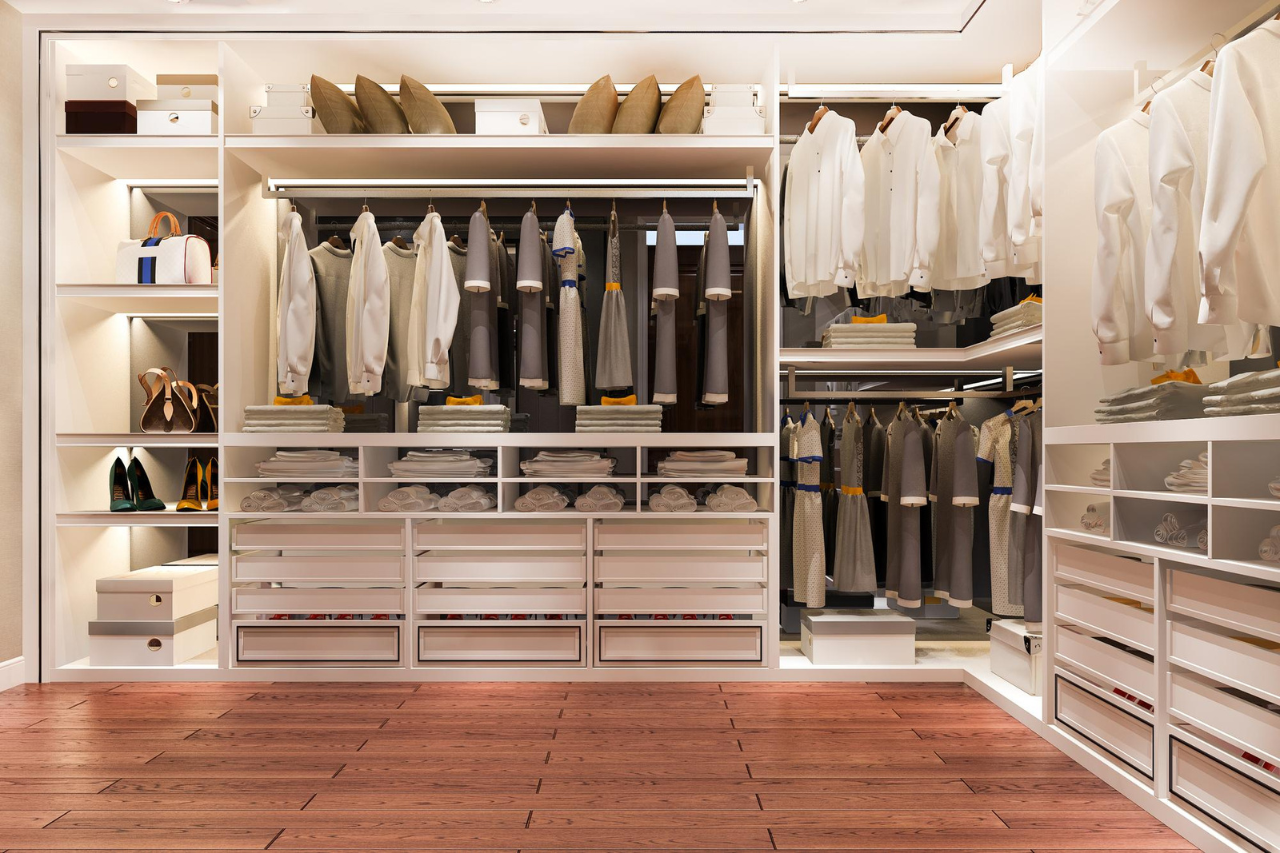
Good closet design is more than an aesthetic choice or a luxury item. This type of furniture brings more practicality to the customer’s daily life, it has a intelligent use of space available and even helps preserve clothing and accessories.
But to achieve this result, it is essential to consider several technical aspects, from the arrangement of the modules to the materials and finishes chosen during production.
In today’s article, Casoca offers a detailed guide on what to consider when specify an efficient and adequate closet to user needs. Look!
Before defining a measurement or material to use in the closet project, the first step is understand the profile of who will use this space.
Consider that a wardrobe consisting primarily of formal clothing will require more space for racks, while casual clothing can be stored in drawers and shelves.
In the case of shared closets, such as those intended for couples, it is important to balance the space in a functional way. taking into account needs and individualities of both parties.
The functional processes of this furniture can also be identified based on the architect’s active listening to the routine of one or more users of this space.
In this way, it is possible to always keep the most used items close at hand, while suitcases and seasonal clothes occupy the top of the trunks.
The shape of the closet depends on the space available and the transition needed. Here, it is essential to understand how the presence and installation of this furniture disrupts the circulation of the room.
Some of the most used formats are:
- Linear: Ideal for small spaces, this type of cupboard has a minimum depth of 55 cm and a recommended circulation of at least 70 cm.
- “L” me: With a format using two walls, this model accommodates more objects and must have a minimum circulation of at least 80 cm for greater comfort.
- I am “U”: This format maximizes the use of walls and allows the storage of more pieces, ideal for shared closets, but requires a minimum circulation of 90 cm.
- Open vs Closed: Open closets provide easier visual access, but require more organization and cleaning because they are more exposed to dust accumulation. For those who are not as organized or simply appreciate more privacy, sliding doors are recommended for closets designed in smaller spaces.
The materials used in a closet project must combine durability and aesthetics. The choice of MDF or MDP as structural base It is necessary to consider the thickness adapted to each function: minimum 15 mm for the shelves and 25 mm for the bases.
Melanin ends They are ideal for interior spaces, while natural boards require more maintenance.
In the case of drawers and slides, choose damping systems and a weight capacity compatible with use. While handles and other hardware should be given priority anticorrosive materialssuch as anodized aluminum or stainless steel.
And be careful: mirrors can be integrated into doors or fixed panels, but they must be at least 4 mm thick and have a safety film to support the weight!
Intelligent organization of a closet requires a well-thought-out division, because each type of object requires a specific compartment. The ideal is therefore to divide the cupboard into specific modules to improve organization and accessibility.
- Clothes racks: must be installed at 90 cm for blouses and skirts, 120 cm for shirts and 160 cm for long dresses.
- Drawers: between 15 and 20 cm depth is ideal for underwear, while 25 cm is recommended for t-shirts.
- Shelves: a distance between 30 and 40 cm facilitates viewing.
- Shoe racks: inclined at 15° to optimize space and facilitate access to objects.
- Maleiros: installation at 200 cm or more for storing seasonal items.
It’s also essential to include an accessories area with storage drawers for jewelry and costume jewelry, as well as space for user-specific items, such as bags or sporting goods.
Proper lighting in a closet is essential to correctly identify colors and improve the user experience.
A combination of general lighting with LED strips made of aluminum profilesinstalled vertically between the modules, is ideal for guaranteeing shadow-free lighting.
While targetable spots highlight specific areas. In case of closed cupboards, presence sensors automate the system and save energy.
The color temperature should be between 3000K and 4000K, providing faithful reproduction of clothing colors. In the case of closets without natural lighting, it is important to provide a CRI (Color Reproduction Index) greater than 90 in the specified lamps.
The comfort of daily use of the cupboard is directly linked to the ergonomic principles applied to the project. After all, a well-executed project facilitates daily use and contributes to the longevity of the furniture.
As installation heights must respect the scope of users:
- Suspension bars between 1.60m and 1.80m from the ground
- Most used drawers between 0.40 m and 1.40 m
- Luggage rack above 1.90 m for occasional use items
While the depth of modules You can consider as a basis of comfort:
- 0.55 m for hangers
- 0.45m for drawers
- 0.35 m for accessory shelves
Oh circulation space It must allow full opening of drawers and comfortable access to objects, including the possibility of use by people with reduced mobility.
A well-designed closet is one that balances functionality, ergonomics and aesthetics. So pay attention: the correct specification of materials, dimensions and compartments makes all the difference in daily use!
Planning based on user needs and organization optimization ensures that this space is efficient and comfortable
Latest Posts Published

Building materials in indigenous architecture
Architect Siza Vieira
Discover the history of Milan Design Week
How to create a good closet design?

discover the program created exclusively for architects and designers
ancient tradition that turns out to be a current solution to heat
11 Great Wireless Smart Light Ideas
Development of farms and barns: rustic elegance in Tuscany

know what they are really looking for