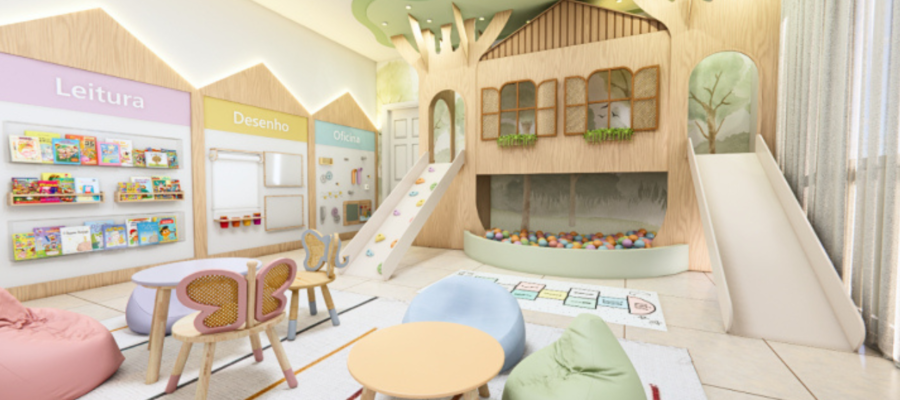
The game libraries are spaces designed to promote learning and the interaction of children in a playful way with elements that promote comfort, allow easy cleaning and are safe for different age groups.
But for all these elements to be present in a suitable environment, it is essential to make a judicious choice of materials and coverings. In addition to respecting current safety and accessibility standards.
With this in mind, Casoca invited the architect Bianca Costa, from Caprice Arquitetura Infantil, to understand the main needs and requirements that the architect must take into account when developing projects in this segment.
Safe flooring in children’s spaces
When choosing materials that will be used in children’s environments such as playrooms, it is essential to understand that they must minimize risks and provide a welcoming space.
But before including them in the project, the ideal is to identify the profile of the target audience, whether it is a residential environment (such as a child’s bedroom or a private toy library), commercial or public (such as schools and children’s areas in shopping centers).
For architect Bianca Costa, understanding the environment is one of the most important steps in understanding the frequency of use and even the types of shoes that will be used by children in that space.
Flooring options like rubber, vinyl and modular matsare indicated by their softness and good shock absorption. On the other hand, common tatami mats or synthetic turf coverings may not be ideal for frequently used public spaces.
“In environments with constant use, such as schools or toy libraries in commercial places, it is interesting to choose materials that are easy to clean and very durable due to the high flow of children,” explains the architect.
In environments with high child traffic (such as hallways and schoolyards), floors such as epoxy (liquid porcelain tile) are also indicated, provided they are correctly applied and 100% cured. The same goes for vinyl flooring which, in addition to ensuring more convenient cleaning, has non-slip versions and ecological options.
However, it is necessary to use shock absorbing coverings in spaces where there is a risk of falling from a height greater than 60 cm. “In this case, modular rubber floors suitable for play areas are the best option,” explains the professional.
Safety standards for children’s environments
To ensure the safety of projects intended for children, it is necessary to comply with all standards established by regulatory bodies.
In Brazil, the ABNT NBR 16071 sets standards for leisure spaces, while the INMETRO certifies children’s toys and equipment, in addition to international certifications such as ASTM and EN 1176 establish specific guidelines for this type of environment.
Another important point to ensure safety in these spaces is to understand the materials used. Items with stamps like GreenGuard, FSC e OEKO-TEX ensure that products are sustainable and free of toxic substances.
For Bianca, it is important to carefully read all the manufacturer’s recommendations to know the brands of products used in space, avoiding, for example, allergic reactions. “Today we have non-toxic paint options suitable for furniture and walls in children’s environments,” he explains.
Furthermore, it is essential that your game library project takes into account the accessibility requirementsensuring an inclusive environment for all children.
Usability for different age groups
Each stage of childhood requires specific solutions to guarantee safety and functionality. For babies it is essential to include soft floors and hypoallergenic materialsas well as low furniture that facilitates interaction.
For children aged 3 to 6, for example, it is necessary to have spaces that encourage exploration, with durable furniture and supervised activity spaces. While for older children, materials with greater durability e modular spaces they favor autonomy and allow different possibilities of use.
For Bianca it is important to recognize the challenge of designing spaces for children where it is necessary to think about safe choices that take into account different maturities, motor skills and stimuli.
“The secret to designing a space suitable for different ages is to sectorize the environment. Creating specific and well-defined areas for babies, young people and older children is essential to guarantee the safety and functionality of the space,” reflects the architect.
Sensoriality in children’s architecture
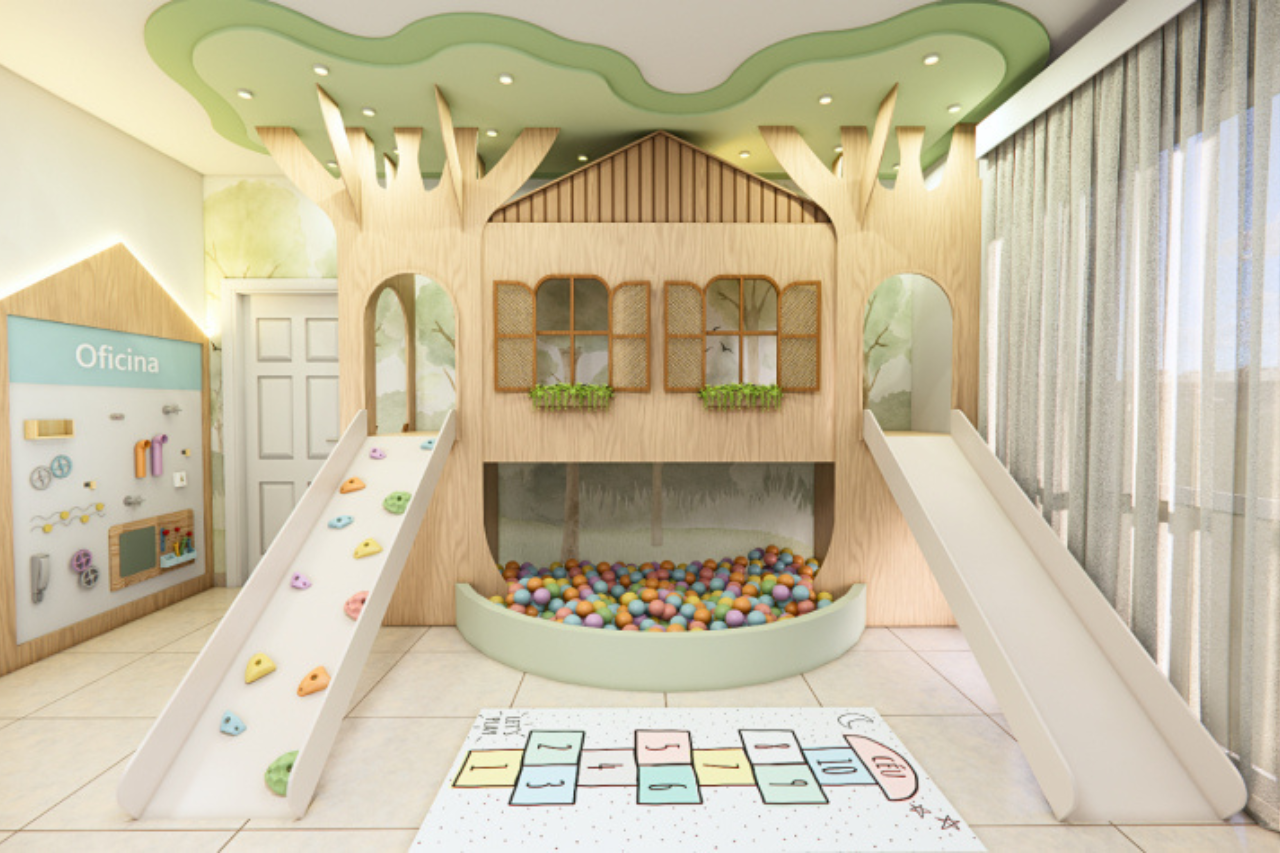
Project by architect Bianca Costa, from Caprice Arquitetura Infantil.
The child’s development is directly linked to sensory exploration, making the presence of varied surfaces essential. Therefore, when designing spaces aimed at this target audience, it is important to include materials that make it a more stimulating and interactive environment.
“Incorporating felt panels, ropes, soft fabrics and different reliefs can enrich the tactile experience in a safe way, stimulating the child’s curiosity and new discoveries of textures,” explains Bianca.
Likewise, the inclusion of wooden objects, tactile panels and other elements promote children’s engagement in recreational and educational activities. However, it is essential to analyze the position of the designed environment to make the right choices when designing.
“When we integrate sensory elements, it is interesting to consider whether the space is internal or external, because certain materials are more suitable for different areas and this affects the usability of the environment,” concludes the architect.
Remember: all these choices have the power to promote learning and offer an even more enriching experience to the end client of your project!
Latest Posts Published
Building materials in indigenous architecture
Architect Siza Vieira
Discover the history of Milan Design Week
How to create a good closet design?

discover the program created exclusively for architects and designers

ancient tradition that turns out to be a current solution to heat
11 Great Wireless Smart Light Ideas
Development of farms and barns: rustic elegance in Tuscany

know what they are really looking for