
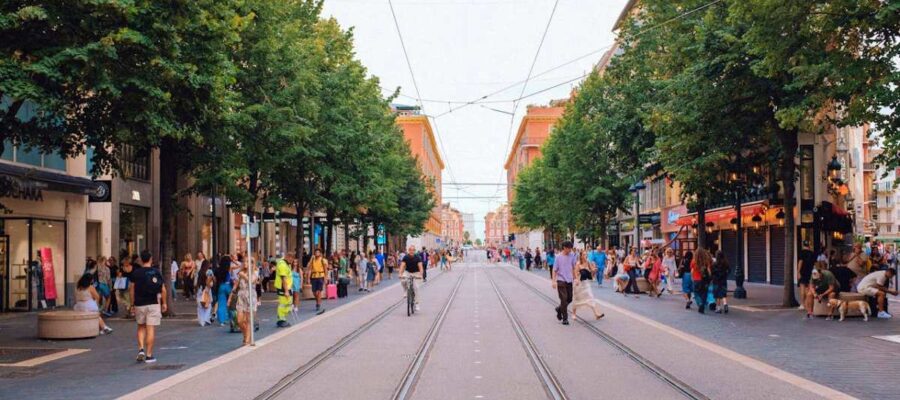
The notion of complete streets has gained importance in discussions about urban planning and urban mobility. More than just traffic lanes, these streets are designed to be accessible, safe and effective for all users, whatever their mode of travel: on foot, by bike, by public transport or by motorized vehicle.
In this article, we will explore the principles of complete streets, their benefits, the Brazilian standards that guide their implementation, and examples from Brazil and around the world. Additionally, we will discuss how urban planners can apply these principles in planning more integrated and inclusive cities. Let’s go?
After all, what are complete streets?
Complete streets are urban roads designed to serve all types of users in an inclusive and efficient mannerwhatever the means of transport used. The concept is based on the principle that streets must be safe and accessible for pedestrians, cyclists, public transport users and drivers, promoting balanced coexistence between them.
These streets are developed with a design that values security, universal accessibility and sustainabilityin addition to promoting an environment of coexistence for citizens. The central idea is to create streets that are more than just a passage space, by transforming them into places of social interactionleisure and economic activity.
Discover the Brazilian standards that support the construction of complete streets
In Brazil, the implementation of complete streets is supported by several standards and guidelines that guide urban development. Some of the most relevant are:
Brazilian Highway Code (CTB)
The Brazilian Highway Code establishes standards for the movement of vehicles, cyclists and pedestrians on public roads. It also provides for the creation of bicycle lanes, bus lanes and measures to ensure the safety of road users, in accordance with the principles of complete streets.
Urban Mobility Act (Law No. 12,587/2012)
A Urban mobility law guides national mobility policy, giving priority to collective public transport, non-motorised modes and social inclusion. This law serves as the basis for the development of Complete Streets because it establishes the need for urban planning focused on sustainability and accessibility.
Complete Street Principles
Complete streets are designed based on fundamental principles that ensure their efficiency and accessibility to everyone.
1) Universal accessibility
Complete streets must include the mobility of all citizensincluding people with disabilities or reduced mobility. In other words, projects must have wide, level sidewalks, access ramps, adequate visual and tactile signage and a reduction in architectural barriers.
2) Diversity of modes of transport and travel
In a complete street, space is distributed equitably between different types of transportation. This includes dedicated bus lanes and cycle paths, as well as pedestrian-only areas. The objective is to encourage the use of alternative transport to the car, by promoting active mobility and use of streets as permanent spaces.
3) Security
Complete streets are designed to ensure the safety of all its usersmainly pedestrians and cyclists. To this end, they are adopting elements such as well-marked pedestrian crossings, refuge islands, reduced speed limits, efficient street lighting and clear signage.
4) Environmental sustainability
Complete Streets is also committed to sustainability, integrate ecological solutions such as green spaces, sustainable drainage systems and infrastructure to reduce pollution. These streets are planned to minimize environmental impact, encouraging the use of non-polluting transport and promoting urban afforestation.
5) Social integration
One of the pillars of complete streets is the promotion of social integration. They are designed to be living spaces, where different social groups can meet and harmoniously share public space. The integration of street furniture, such as benches, squares and shaded areas, makes these spaces more welcoming.
What are the benefits of complete streets for residents and users?
The creation of complete streets brings a series of benefits to both residents and users of these roads. Some of the main ones are:
Better urban mobility
Complete streets facilitate the flow of pedestrians, cyclists and public transport users, reducing travel times and traffic congestion. By favoring sustainable modes of transport, these streets contribute to reduce dependence on private vehicleslike cars and motorcycles.
Quality of life
Residents’ quality of life is directly impacted by complete streets. THE reduction in car trafficcombined with green spaces and living spaces, this results in calmer environments. In addition, the presence of cycle paths and safe areas for pedestrians encourages the practice of physical activities.
Sustainability and pollution reduction
By promoting the use of transportation such as cycling and public transportation, complete streets help to reduce air and noise pollution. Afforestation of roads also contributes to carbon sequestration and improves air quality in urban areas.
Social inclusion
Complete streets are democratic spaces. The presence of common spaces and universal accessibility ensure that everyone can benefit from public space in a fair and equitable manner.
Real estate appreciation
The creation of complete streets tends to increase property and business values around you. More pleasant and accessible environments attract new investments and revitalize previously undervalued areas.
Practical examples of complete streets in Brazil and around the world
Several comprehensive street projects have been implemented around the world, with positive results. Let’s explore some inspiring examples, in Brazil and other countries.
Sao Paulo, Brazil
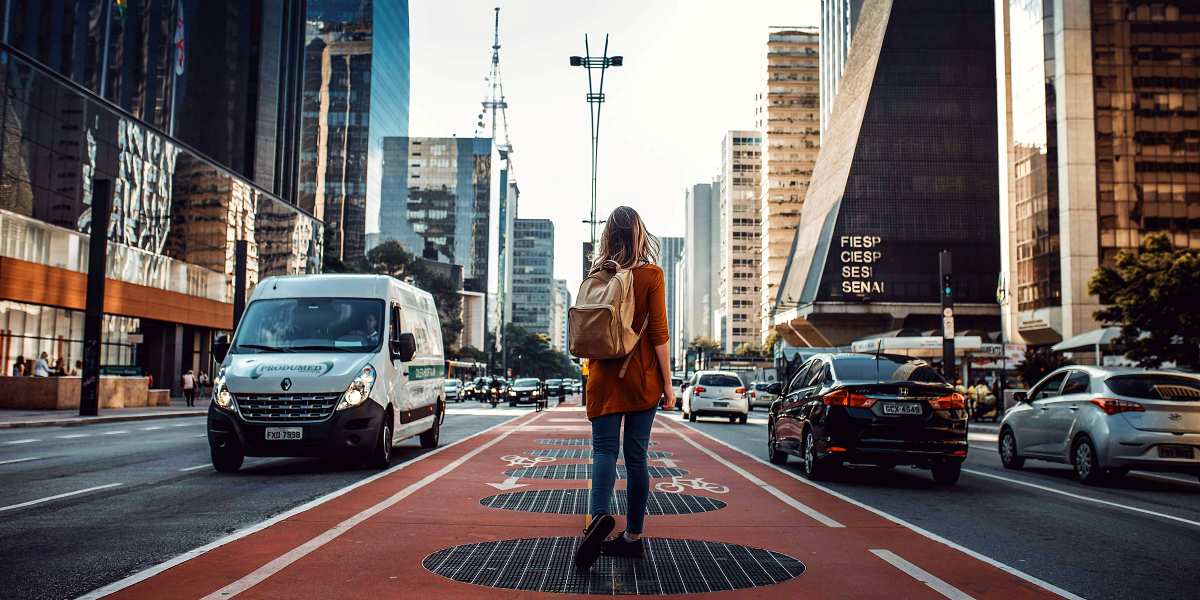
São Paulo is one of the Brazilian cities that implemented the concept of complete streets. THE Paulista Avenuefor example, has undergone a significant transformation in recent years, with the creation of cycle paths, the widening of sidewalks and the reduction of space allocated to cars. The project aims to make the avenue more accessible and pleasant for pedestrians and cyclists, and constitutes one of the most visible examples of a complete street in Brazil.
Rio de Janeiro, Brazil
Another example of a complete street in Brazil is Orla Condéin Rio de Janeiro. This project revitalized the city’s port area for the 2016 Olympic Games, transforming it into a priority space for pedestrians and cyclists, with common spaces and universal accessibility.
Boston, Massachusetts (United States)
The project Complete Streets of Bostonone of the best-known examples of complete streets in the world, is based on three main pillars: mobility, sustainability and coexistence. The city of Boston has invested in infrastructure supporting public transportation, safe bike paths, green spaces and social spaces, making its streets more accessible and functional for all users.
Barcelona, Spain
Barcelona stood out for its super islandsor “superblocks,” which prioritize the use of public space by pedestrians and cyclists. In these areas, vehicle circulation is restricted and space is reorganized to promote coexistence and sustainability. The project has inspired other cities around the world to adopt similar approaches.
How can city planners use this principle to plan more integrated cities?
The Complete Streets Principles provide a clear roadmap for urban planners seeking to plan more inclusive, sustainable, and integrated cities.
By prioritizing universal accessibility, diversity of transportation modes, safety, sustainability and social integration, urban planners can transform public space into a more democratic and functional environment. Professionals in the sector thus contribute to the development of more connected cities, where all citizens can benefit from the advantages of a more efficient and inclusive city.
Latest Posts Published

Building materials in indigenous architecture

Architect Siza Vieira
Discover the history of Milan Design Week

How to create a good closet design?

discover the program created exclusively for architects and designers

ancient tradition that turns out to be a current solution to heat

11 Great Wireless Smart Light Ideas
Development of farms and barns: rustic elegance in Tuscany

know what they are really looking for